Tuesday, May 12, 2015

Question 2: From India With Love

Don Dela Cruz
05/12/15
P.4 AP Lang


Question 2: From India With Love

     The depiction of migration or adaptation confers an argumentative discussion of strength and weakness; its involvement in historical events and passages conceive a plethora of ideals to another time where movement was accepted, progressive, and normal. Nowadays, a movement or change in landscape or lifestyle dignifies weakness or lower stature. Scott Russel Sanders writes "Staying Put: a Home in a Restless World" in response to Solomon Rushdie for the sake of evaluating another's perspective on the two sides of mass migrations, and by using specific language techniques, Sanders sheds light on the topic's core meaning of substantial ideas. Breaking his essay down, understanding the author's point becomes much easier to seeing his strategy.

     Sander's writing reflects his part on perceiving the discussion and how he uses tone and tricks to alter or persuade audiences abroad. One point is the unique tip of using first-person point of view engagements, or words, to suffice an introduce showing individuality and creativity. "One hundred years after the closing of the frontier' we have still not shaken off the romance of unlimited space." The author's usage of the classic pathos, ethos, and logos triangle conveys the connection the author strives for between the speaker and audience. "In our national mythology, the worst fate is to be trapped on a farm..." This excerpt ideally shows the narrator's view with the use of words like "our" to support the push on audiences' appeal, and ironically, the hasty generalization becomes a strong and clever strategic route to by pass logically fallacies as a way of persuasive writing; the author writes "our national mythology" and presumes an entire nation to support his idea on migration, which can prove contrary to millions of others' individuality in thinking. Surprisingly, Sanders uses patriotism as a technique to change the audiences' minds. 

     A common displacement of clever, persuasive wording in the history of speeches, arguments, and basic ganders vain thinking can be a manipulative way to the reevaluation of perspective. Sand

Friday, May 8, 2015

Question 1: Revised Daylight Savings

Don Dela Cruz
04/15/15
P/4

Daylight Savings: Why?

     What once started as advice for candle saving by the famous Benjamin Franklin is now a global adaption to daily life; daylight savings has become a necessity to society's years in life and how measurement of time and moments have become man-made ideals. The repetition of adjustment in time seems utterly common, as if the world just adopted it naturally. While it seems this way, daylight savings is still an arguable factor to some nations' lives. Using several sources, the complications of the topic can be understood and analyzed. Is daylight savings just a method of federal uselessness or is it a significant part of overall greatness?

     Daylight savings is adjusted automatically via electronics and appliances, but does this mean it is a necessity to the already complicated life systems? The excerpt from the article "Energy Bill Would Extend Daylight Savings Time" by Robert Loigley explains the only society which seems to benefit and use the energy method: "...show that America's electricity usage is reduced about one percent..." In another excerpt from the book "Seize the Daylight: The Curious and Continuous Story of Daylight Savings Time" by David Prerau, the author explains its statistic usage in benefiting society by conserving enough energy to reciprocate other priorities; "...the extra hour of light in the evening could cause an increase in recreational and shopping travel by automobile..." Because we do not entirely mind the existence of something as ordinary as Daylight Savings, society does not completely understand its origins or purposes towards past society and how it had been used before. Not only does Daylight Savings Time endeavor the conservation of energy, but also physical safety to humans. 

     It seems rather obvious that Daylight Savings Time ties into the relevance of sunlight and energy, but much of its significance is also for human safety and precautionary methods. In another excerpt from David Prerau's, he writes "People feel generally safer in the daylight, and many types of crime are believed to be influenced by lighting conditions" It seems, on a more realistic note, that the purpose of daylight savings is to extend time with light and how it can help/support the importance of safety. In Source D, a graph from an article proves how daylight savings improves statistics of crashes and drastically changes afterwards. The fact that statistics give support to the ideals of daylight savings gives a better viewing of positively seeing the idea as an opportunity rather than a burden. Because of this creation, the scene of car accidents and death would not plague the universe due to its natural habitat of occasional darkness.

     As an ignorant American mindlessly following the herd of sheep to do whatever my superiors say, I have ignorantly never bothered to understand something as inventive and innovative such as daylight savings. It becomes a tedious idea due to its relevance in only occasional times of the year, yet the turning of a clock backwards or forwards seem so far from relevant. This ignorance causes me to realize that I should be understand and evaluating even the tiniest nook and cranny because in some odd way, industrialization brings forth the idea that most of everything we do today is a measured spectral of man-made knowledge. 

Portfolio Reflection

Don Dela Cruz Jr
04/27/15
AP Lang. P.4


Portfolio Reflection

     In a nutshell, my portfolio represents the utmost mediocre writing and a skill level that proves to need improvement and enhancement. While many can say their portfolios illustrate the character of one's self, I believe my writing only deciphers my level of opinion rather than overall intellect and persona. In some odd perspective, literature suits me well; it is an area that does not require expertise, accuracy, or academic grades, but prioritizes the individualism and thinking that can differ throughout other minds. Let's first understand what exactly is in my portfolio.

     The portfolio, which can reflect the ambition I have towards working, may seem no more than irresponsible and fatigued; there's a point where work can be habitual or a chore and where work can be deciphered as art, passion, and creativity. I believe my portfolio lacks many assignments, yet the ones in which are present completely deflect the ideal that presumes my mind to be lower than I perceive it to be; a mind capable of so much more. This possibility of intellect intrigues and frigtens me because in the end, with all the hard work I've dedicated myself to, my grades fall short to my false impression of myself. This causes me to discourage any other effort to better myself because the outcome pervasively remains the same negative ending. As I write this paper, it becomes relatively simple to the solution of my issues: give up. 

     The portfolio might be the only conclusion to my issues due to the evidence that I somewhat enjoy challenging myself and the academic duplicate society has created for me. It's a glimmer of hope that one day I can fit into the ideal citizen' a well paying job, beautiful home, and a nice life. I see now that my loss of passion to something as simple as education can deduct the strength and will found in my inner self, which plays such an essential role to find success, nirvana, and conclusions. In such a promiscuous way, I have found my mental barriers to hold down the possibilities and opportunities I attain by simply pitting myself down. Society tells you to be realistic and settle down, yet what motivates me, personally, is the ability to believe in a world or goal where I can be and do something much bigger than what was meant or assumed for me to become. "The Sky is the limit" is another vague and cliche method of promoting positivism, but what makes the lesson much more meaningful, not aloof, is by applying it to each aspect of your own lifestyle: being positive mentally, physically, socially, intellectually, academically, etc. 

     How does this entire paper answer all the questions on the "Portfolio Guiding Questions"? I am trying to put forth to my audience that "I am a big fish in a small pond" I have been limited to achieve any high goals, from grades to report cards, simply because I have not realized how lazy and ridiculously pessimistic I have become. It is no doubt that this class has truly altered me and how I perceive education; with all the books and lessons we've learned from, I realize that some classes such as this one develops the form of ambiguity and ambition to endeavor in much larger goals like a career or higher thinking. The ability to compensate for such a bad year is by reflecting on it and realizing how productive you have become even when it seemed so useless and pointless. For some odd reason, this will be a class to be forever cherished. It was a class that witnessed my highs, my mediums, and my lows, which can also configure the meaning to my blog subheading: "While I struggle to find myself, one day, I will witness my inauguration...". The blog subheading simply puts my year as an AP Language student into a sentence---I struggled to stay positive and clear throughout this entire year of learning, yet I look back within this assignment and realize I have come so far. My ability to analyze, my ability to write, and my ability to organize has become comprehensibly skilled. I am no Charles Dickens nor am I a John Kim---I am Don and while I do not succumb to anyone's particular standards, I will accept myself fully one day, and because of this class and progression, it seems evident that the idea might be closer than I think. 

Sunday, April 5, 2015

Correction 4/ Textbook Work

Correction 4

  1. B
  2. H
  3. D
  4. H
  5. B
  6. G
Prompt

     Stephen Crane's poem, in my opinion, seems relentless, sad, and drastically affluent to a society that belittles its people. Crane writes his poem of war; a very complicated battle that involves physical, emotional, and mental harm. Stephen Crane seems so intrigued by the idea of war, and a supporter to the soldiers who fight in it, but is so discouraged by his own abilities where he claims he cannot be one (he believes he is not strong enough or willing). What seems to be a poem on war and violence becomes a poem of self-belittling and lacks a sense of self-confidence. It's a poem of war but not between nations, but between man and himself. His lack of confidence and his willing to make him smaller than the rest of the soldiers, or in other words "people", causes the reader to understand the insecurity and hopelessness of the author and how weak one can become after a war with himself. Getting into the other poem by Komunrakaa, both poets seem to follow each other's steps and art when it comes to the different aspects of writing such as tone, mood, and theme. Both share a tone that seems less optimistic, more pessimistic, and much more queer and peculiar than most poems due to its strong reflection-of-self and its passion to mirror an image of what the author believes he is or what he should write of (the nature of man). They both write about the natural environment of outlandish behaviors and the anatomy of the human mind and its critical significance to feeling the meaning and importance of one's self and one another.

Correction 3/ Textbook Work

Correction 3

  1. C
  2. G
  3. A
  4. G
  5. C
  6. H
  7. B
  8. J
Prompt

     Whitman and Baca are both two revolutionary thinkers in the eyes of the poetic/literature world. Whitman, known for his soft and gentle words, collide with the everlasting deep and meaningful rhymes from Baca in this textbook work. The given poems from both poets share similar traits such as morals and rights (existentialism), yet they represent different opinions and beliefs in each other's writing. Whitman, in my opinion, has the upper hand coming forth as the optimist; he writes on society and people as a positive and much more hopeful generation rather than Baca. Baca writes in a more individualistic way; a ballistic approach to how society manipulates its own decisions and causes its own alteration through time. He then seeps his own opinion on natural depletion and natural changes in society through his writing.

Correction 2/ Textbook Work

Correction 2:


  1. B
  2. G
  3. D
  4. H
  5. B
  6. G
  7. D
  8. J
  9. A
  10. H

Prompt:

     Both authors and poets Edgar Allan Poe and H.D view different aspects when it comes to Helen. As an avid reader of Poe's art, his usage of similes and analogies becomes apparent when seeing the visual description he has towards Helen's beauty. On the other hand. H.D uses social behavior and awkwardness as a way to describe his point of view on Helen and her own traits. Edgar Allan Poe, as dark as he is, seemingly becomes more lenient and graceful towards the feminine nature and idea of Helen, a beautiful, loving woman, whereas H.D seems to be much more critical and judgmental to the gender. It becomes clear which side Poe and H.D are on the likeness of the subject "women"; Poe shows more grace and appreciation towards his opposite sex while H.D shows structural, stiff critique that represents a strong non-suit towards the sex.

Correction 1/ Textbook Work

Correction 1:
1)A
2)J
3)A
4)B
5)C
6)H
7)C
8)H
9)A
10)F

Prompt:

    The two poems both ingrate a different depiction of one topic: love. Love is a common theme between both poems, yet each one has its different aspects of emotion, writing, and perspective. For example, Bradstreet's poem seem alike to the meaning in Millay's, yet founded in a completely different way and its alternative way of understanding love and romance can become clarified to understanding or analyzing the author and his background. Bradstreet's poem becomes obvious that it is more likely to romanticize and charm the easily understood people and common love, yet Millay's way of thinking to depict or shed his knowledge on love is to use subliminal and hidden meanings that takes more than just reading, but thinking to compensate for such complicated writing.


Saturday, April 4, 2015

Don't know why I did it but I did.
It's incredible how can one set of words can be so easy to say, so easily misinterpreted, yet so easily felt. While it is mistakenly one of the easiest things to say, it is one of the most difficult; not physically, but emotionally. Life depicts its meaning in so many different ways: in lust, in stupidity, in naivety, in high hopes. 
It was said too fast, too soon, too early, yet felt so right and so natural.
Nothing like the feelings of discomfort, anxiety, stress, and curiosity---only a few words which can replicate the way one feels with the blue haze of emotions that sought from the amount in which the person means.
It is the feeling of the serpent's venom causing waves of pain and misery towards its victim---a pain that subsides not only within one area of the body, but overcomes the body and mind.
It is hard to escape the treachery; the pain and the suffering, because in the end, the serpent was worth the bite. The thought of the serpent and its fangs can bewilder, yet become so heavenly and angelic. The thought of the serpent can linger for hours or it can sneak itself within seconds, yet in the end, its thought becomes so much more than just a meaningless spot in the galaxy of the mind, but a colorful dream that one carefully examines, one carefully plots, and one carefully hesitates over because it so important, ideal, and essential.
In the end, the pain is worth the bite. And however flesh-eating, blood-sucking the serpent will be, it will still be worth it.

Friday, April 3, 2015

Los Angeles Riots

Los Angeles Riots

Interview of Mother

DON DELA CRUZ~~~~~~~~~~~INTERVIEWED: MOTHER

1) I was living in Los Angeles at the time, in the same home we live in today, in Hollywood. 

2) I remember that I was 9 months pregnant with your older sister when it was happening, and many bizarre moments had occurred when I was around town such as being in the middle of a drive-by shooting.

3) The news and media made the riots sound terrifying and very violent, and focused on the colored people.

4) I knew a local Filipino store that had been looted during the riots and had much of their merchandise and money taken and/or destroyed.

5) Civil Rights should not enlighten the idea of riots because it only causes more problems and death than it first started off with (racism and violence towards colored people)

6) It is hard to believe that all of it happened due to the incident of Rodney King. It was a good thing that people became passionate about their fellow peers, but it should not have reached to violence, theft, and everything else that the colored people are blamed for in the first place (stereotypes, racism, prejudice beliefs).

7) It was just chaos within the Los Angeles parameter. There was loot, theft, assault, murder, and basically a state of emergency in Los Angeles all under the belief to rebel against society. It goes back to the riots of the Civil Rights Movement or even fast forward to the riots in Ferguson. Each lack the ability to cope with an issue head on and without physical harm because we were brought up into a society that shapes our belief to passionately and aggressively fight for our rights.

8) I would like to share that it is completely insane that people will prove their superiors right when they are provoked into violence and inhumane acts due to not being able to control our emotions and adrenaline. Society has produced generations of youth that cannot deal with their own problems and must act out onto other issues without control. 
 And to believe that all this carnage and despair all happened in our city, a place we call "home" 

Saturday, March 28, 2015

Question 3: Rights of Man

Rights of Man: The Division of an Empire

Question 3

The force of modernization and the world of urbanism glorifies the ideals of American culture from incredibly technological inventions to the many colors and backgrounds found in our community. In the book "Rights of Man" by Thomas Paine, the idea of independence and self-governing in such a setting like America promotes a sense of diversity and cultural unity that, in the of time the, did not seize to exist. Paine exhausts into England a message for reasonable expulsion of the branch of the motherland and to exceed the limits that America would disparage in such a simple time. Let's first analyze the body of work.

"Made up, as it is, of people from different nations, accustomed to different forms...different languages" The author's goal is using the excerpt in the opening of his body was to target the issue of the elephant in the room that cultural differentiation along with color and looks, were very uncommon, yet very obscene in society then. Paine pointed a picture that would visualize a world of oddity, eeriness, and even strangeness---but it causes curiosity and somewhat opportunity. In the America today, society is very similar and relatable to Paine's theory on American idealism; much of America cannot even dignify one substantial race because, realistically, the country unifies cultures and skin colors from all over the glove. Just as Thomas wrote "more different in their modes of worship" This exemplifies just one of many components to the country's diverse approach to the various amounts of religion or beliefs. America could not even be named pure due to its incompetence to holding entirely one-raced generations back decades before the ancestors who held this nation together resigned from afar. The composition of unity was after all true, but let's see what Paine was contrary to. 

When Paine wrote the book, he might have overestimated America and its ability to succeedingly remain a "just" country, Paine writes, "and all the parts are brought into cordial unison." Nowadays, the country experiences oceans of issues which conspire the meaning of "justice for all"; racism, sexism, poverty, and so many simple ingredients to life are bewildered in this illicit country. "There, the poor are not oppressed, the rich are not privileged...then taxes are few..." it becomes obvious that Paine did not surpass the faith-enriched boundary beyond the 18th century. In fact, every day people, from rich to poor, are living out of balance in both positive and negative ways: the poor only get poorer and the rich only get richer. The author's hope for the community could have worked, but many great leaders fell to the victimization of greed and power. Although diversity and unity do exist, so do the destabilizing factors of malice and deceit; causing an uproar of violence, illusions, and dishonor in the system. 

While Paine hit the diversity culprit right on target, his opinion and point on justice and unification were sadly miscalculated. America is oddly enough such a jungle of macabre felines and animals fighting be on top with its predicaments of weaponry, power, and degradation of one another. Our cities are filled with diversity and multi-cultural communities, just as Paine promoted, yet we contradict his ideology by oppressing one another because of those differences. It is a sort of burden to lack common traits; to be accepted or satisfactory in such a society is to be another sheep in the grass, yet when we see an individual with personality or some glimpse of power, we look down upon him through reputation, manipulation, and through a cross-hair. As smart as Thomas Paine was, no one could have been prepared for the tables to turn when America became the country of a nonexistent freedom. To be able to accomplish what Paine believed in, we must grasp awareness to our youngest folks and oldest Yankees to understand what America was sought to be. 

Question 2: Nerds (First Draft w/ Revisions)

Nerds: Society Heroes or Weirdos

Question 2


What was once a privilege and blessing of knowledge and education in society is now a seemingly embarrassing and shameful trait to have and reclaim as one's better attributes. "America Needs Its Nerds" by Leonid Friedman is an interesting passage that depicts an opinion of modern society that many can relate to; an argument that would be able to suppress society of its materialistic, primate generation of students. Fridman uses citations and statistics that would alter the audience's opinion, and also relatable emotional appeals to be able to grasp the speaker's intended lesson. To be able to understand the author's writing style, one must look at how the author lays his information out in a cunning sense of interest. 

"It is a telling fact about our language and our culture that someone dedicated to pursuit of knowledge is compared to a freak biting the head off a live chicken." Fridman introduces his opinion and belief by entertaining the amusing level of a social distortion found in today's generation; this method produces interest towards the subject and its ideals. He also writes "For America's sake..." as a tool to succeedingly  exceedingly relate his writing directly to an adaptable audience, which is commonly the average American. In much of his writing, he attempts to persuade an audience to abide by his word with amusement, nonchalant seriousness, yet adds depth and meaning to his laud back sense of comparisons. Another tool used for persuasiveness had been facts and statistics. 

Throughout Fridman's essay, much of the compelling statements and words that alter one's opinion is in the hands of stats and facts used by the author. Citing "A Webster's New World Dictionary" directly, the author gains a subconscious trust between the reader and writer instead of pulling out information out of one's own library of words obliviously. A combination of emotional appeal and statistics is also witnessed when reading about the significance of social distress in American education. "But not in America, where average professional ballplayers are much more respected and better paid than faculty members of the best universities." Excerpts like this could endeavor Fridman's ideals to readers and understand how their world was being affected and not just the narrator's.

Society builds the foundations of its communities, yet it also proves contrary to itself to endeavor in modest knowledge and fair subsidies to the hardships of everyday life. While we are pushed to be the ideal citizen; a happy, working, law-abiding man, society hypocritically commits various acts of malice and deceit but still questions the harmful nature in which cycles through its people. Just as parents are to their children, society is a reflection of its communities. While the perception of nerds have become less restricted since the 20th century, it still begs the fact that other topics and categories of life are being misinterpreted and lacks equilibrium between good and bad---right or wrong. Fridman simply writes to entertain his readers, yet are there within facts. 

Wednesday, March 11, 2015

NUCLEAR POWERRRRRR


Nuclear Power

Efficient or Too Advanced?


The significance of the environment has been extremely relevant in recent days due to the harsh changes that has occurred to many of the world’s attributes such as our temperature, our resources, and much of everything we need to survive in this world. In recent years the topic of Nuclear Energy became an essential discussion; would it improve energy efficiency, financial debt, and other issues? While it seems so positive and incredible due to its extraordinary usage, Nuclear Power can both be a blessing and a burden to our society. As the essay develops, the power technique might not be too advanced and difficult to achieve at this particular time in life. Using several sources from the internet, it becomes obvious which side of the topic this essay will become. First off, how can it possibly become a burden to the world?

Nuclear Power is the usage of converting solar energy into a useful resource such as electricity. Its introduction to the world might have sounded so new, so advanced, and so crazy. It’s as if we were going into the future; a technology that would seemingly cause less issues, financial riddance, and social development. Its pro of not being able to exhaust Carbon and become efficient enough to support a community had been evolutionary; a huge step into humanitarian and advancement. How can such technology become a problem, even an issue, to impacting an already damaged world? In the YouTube video “How Nuclear Energy Works”, Dr. Patel explains how nuclear energy differs from traditional methods such as burning coal for heat. “Unlike burning coal and using natural gases, nuclear energy uses It’s safe to say there are possibilities of disaster and issues. Years ago, we can look at the Fukushima nuclear power plant disaster and argue how incredibly dangerous having nuclear plants and energy can be.

While nuclear power can seem so safe and seemingly irresistible, there are some cases in which nuclear power can become a very sensitive topic in the world. In 2012, Japan experienced a radioactive disaster which would change the perspective of many people on the basis of safety and nuclear energy. The power plant that had struck as a disaster caused a tremendous amount of alterations to the environments traits such as water and air. Because of the explosion at the nuclear plant, the surrounding area of Fukushima would be permanently affected by radiation found due to the nuclear energy and reactors spreading atoms and uranium all throughout the space. “After two weeks, the three reactors (units 1-3) were stable with water addition and by July they were being cooled with recycled water from the new treatment plant. Official 'cold shutdown condition' was announced in mid-December.” According to the website, the Fukushima incident would cause an uproar of devastation from the earthquake to an actual tsunami.

Fukushima might have been one of the most alarming situations of nuclear energy, but it should not stop the continuation of a scientific improvement that could possibly save so much more than just money. Nuclear power can be the reason why our skies become brighter, our water can become truly clean, and our people can become healthier. Disregarding the nuclear plant explosion, many of today’s common methods like the usage of natural gas or oils involves an abundance of extra energy such as the use of heavy machinery, the burning of fossil fuels, the extermination of habitats, and more. While nuclear energy can become a difficult adjustment to everyday society, it can be done and can truly affect society positively. Some might argue about its financial burden, but one can question the priorities of its government when wars can be declared yet slowly expanding our nation as a environmentally friendly country can become an issue to the development of such a noble idea.


Citiations


"How Nuclear Energy Works." YouTube. Ed. UAE Nuclear Energy Education. YouTube, 30 Dec. 2009. Web. 12 Mar. 2015. <https://www.youtube.com/watch?v=VJfIbBDR3e8>.


Nuclear Association, World. "World Nuclear Association." Fukushima Accident. Worldnuclear.org. Web. 12 Mar. 2015. <http://www.world-nuclear.org/info/Safety-and-Security/Safety-of-Plants/Fukushima-Accident/>.

Kashikawa, Masami. "Fukushima Four Years After Nuclear Disaster." The New York Times. The New York Times, 10 Mar. 2015. Web. 12 Mar. 2015. <http://www.nytimes.com/interactive/2015/03/11/world/asia/fukushima-anniversary.html?_r=0>.

Wednesday, January 28, 2015

'The Interview' and North Korea Controversy


Two Comedians and a Notorious Nation

'The Interview' and North Korea


     It has become one of the most controversial events of our time; an event that is ridiculously mixed with the ingredients of humor, entertainment, action, and realistic violence. The movie "The Interview" became a world wide sensation in the sense of shame, foolishness, and comedy, to slowly churn the political and societal views into thinking of something much greater; a movie that contained an explosion of deeper meaning and generated a message of battle. It is not rocket science that this opening of such a film has caused controversy and talk about the birth of what created the idea; had both idiotic actor/directors go over their heads and crossed a line? What had been the primary derivative to such a form of entertainment or even, had it been in purpose for entertainment? Here is a sort of review, criticism, and essay hoping to portray the whole ideals in my own words. Had this movie been purposely used to infiltrate nationalistic rivalry, was it plain stupidity, was it a mix? Let's first clarify the plot line in the "The Interview".

     James Franco and Seth Rogen bring you "The Interview", a movie that will be notably one of the most important and significant films in their careers not only due to its laughs and rating, but the fire that it has caused not only in the entertainment business of movies, but the fire that has been sparked into political and deeper distress. Both Franco and Rogen commonly appear in movies such as "Pineapple Express" or shows such as "Freaks and Geeks", presumably what gives their names an entitlement of general stupidity, hilarity, and laughter. Both actors have revolved their lives around the world of the media, being seen all throughout funny movies, TV shows, and the social media. Arguably, the movie had been quite funny, in my opinion. With these two collaborating once again for such a highly criticized movie, there is no doubt that the movie contained incredibly dumb scenes and vulgarity, but what made this movie full of impact was its blunt, yet subliminal meaning to showing viewers of the horrors of North Korea and its issues,

     "The Interview", after watching, is an extremely sensitive scenario that caught not only my eye, but nations all around the world. The destruction had been maximum, but the actions were minimal; the movie was your average comedy with vulgar scenes, nudity, racism, and all the other things founded in their past movies. The movie did not fall short of any sort of vague scenes because all throughout, it had been funny, live, and action-packed. Aside from all the stupid jokes were the strongly horrid elements of betrayal, corruption, and deception when the plot begins to unravel. One of the protagonists of the story, Dave Skylark, a popular TV host, begins to get emotionally close to the dictator of North Korea, Kim Jong Un. This brings up the strength of comedy within the plot because it causes many to think and feel as if the movie had been created to target realistic events against North Korea. As Franco's character is deceived to believing that Kim Jong Un's nation is under control and very underestimated, you begin to realize the significance of such a film. The dictator in the film simply juiced the main character's wants and desires through the power of materialistic and vulgar components such as women, money, strength, and power; Dave had been so easily blinded by the materialistic and fake side of the dictator, that he did not remember that he was dealing with such an extraordinary character of intelligence and manipulative behaviors. Dave dances with the devil and does not even realize it. He sees the evil in his soul when it comes down shame upon his name; a dinner with all the generals and Dave finds a screaming, violent dictator at his side. Bewildered and shocked, Dave leaves the room for some air, and finds himself in a cold world that was falsely an illusion created to make North Korea look sustainable and stable. A simple civilization idea such as the grocery store was set to deceive others outside of the store to think there is a store full of stock, but it was an illusion created with fake fruit and a background. Riled by rage and the feelings of betrayal, Dave confronts him on the important "Interview" that they had planned with the dictator; instead of talking of potato yields and irrelevant topics, Dave realizes the importance of the confrontation which will conspire a whole world of understanding that Kim Jong Un and his reign of power deserves to be treated not as divine, but of vulnerability to a mortal being.

      It dawned on me that it had been apparent to the fact that the movie did indeed become a weapon of some sort, but only to some. To many, it is a harmless, comedic film created by two hilarious actors, but to others, it is a message that is being sent to nations all over the world; that possibly we are now reacting against the Anti-American ideology found in North Korea. The movie infiltrates a very sensitive subject in realism of the rivalry, militarism, and manipulation found within North Korea's short-term historical impact. It seems vile to perceive this movie as simply another B-rated movie; its oblivious irony seems almost transparent compared to the heavy laughter of stupidity, which makes the movie and concept funnier than it is because the truth is right in front of us, but with the sprinkling of comedy and funny faces, the truth is hidden in plain sight.

REALITY

The reality of the general idea is that while the movie can contain fictional basis of information, it uses comedy to cause a layer of fictional belief on such a malice truth. A viewer ignorant to what is truly happening in North Korea can withdraw a large sum of knowledge through the film. One could not even tell if what was happening in the movie was a reflection of truth into realism; such as the assumed idea that the dictator withheld such power of non-human abilities (like the lack of need to use the bathroom or to obtain an anus). 

Heading home, realizing how controversial such a film can be, the viewer can take his in-depth entertainment into another level of understand, knowledge, and compensation for the lack of information known to such a society. It seems society paints pictures of different areas and environments that will already have an embedded theme to it, for example, South Central to be the home of the colored community and criminal activity, or Africa as a home of poverty and famine. It might never occur to some that an Asian country, specifically places such as North Korea, can contain so much hate, falter, and illicit manipulation to be main ideals to leading a land. 

It is not prejudice or racism that builds the argument, but within the limits of an unknowing student who pursues disbelief and tries to evaluate his/her own contrary perception. It can become baffling, startling, and shocking to know that the dictatorship of the country created such a large issue without getting too much spotlight on it. In some ways, it can be viewed as the Holocaust, but of a man's own blood. Hitler, a man of fearlessness, manipulative ideals, and violent ordeals, seems to weigh off the standards of the Kim family. The Germans simply blamed others for the falling of their own community, willing to use nationalism and pride to fight other countries to power. Unlike the Germans, who in very peculiar ways seem to grasp a figure of basic human thinking, the North Korean dictatorship and its ideology of power seems rather macabre; a society solely built on disillusionment, fascism, aggression, and fear. The Germans did not reign abuse or violence AGAINST their own people, but to others who they believed deserved it. The Kim family will exterminate, starve, and mutilate their own people to simply prove that they are willing of such power and incredibly insane reputation. While the Germans have no right to be called "better" than another society, seeing as they have exterminated millions, the North Koreans are a different breed of evil. 

North Korea, in how I perceive societies to be, will be one of the most sadistic and brutal countries of all time. Their country runs on such a confusing mentality of how power should be held and forced upon. Due to the 1950s Korean War, North Koreans have always viewed America as one of the only targets upon the Earth, yet they reign their attacks amongst themselves. Dating back to the Japanese American rivalry, we can reflect the act of the Koreans to the Japanese air-force who had committed the act of "kamikaze". Culturally, these two nations share an ideal that will carry throughout generations of humanity: pride. The Japanese used the method Kamikaze in order to fight the heavily industrialized America for the sake of pride and patriotism to not their country, but to their blood. Kim Jong Un does not seem to purposely kill his own people, but also does not seem to care much because it shows his relentlessness; his hate, his madness, and his divinity against the world. He is viewed as a God; a man who knows no boundary, a man who is pinned upon every room, and a man who has brainwashed his entire population.

Now this is the problem and where we as common people can become heroes of our time: we must simply know and strive for the knowledge of our world. It is simple, but hard. With all the materialism and affluenza that just dictates our world as metropolitan Americans, we forget that our life has been in bubbles. This bubble of American protection subsides the reality of the outside world; a world of poverty, famine, disease, and death. Because we Americans are so ignorant and oblivious, the best action is to just understand and remain determined to pursue knowledge that is outside our own jurisdiction. By understanding all the flaws and problems, we can use the power of our voices to fight the fight that no rifle can fight---that no tank or airplane can explode. In my own perspective, my goal would to be in depth with the issues of the world such as this one. We read our history books and think these wars and battles only occurred outside of our comfort zones; our homes, our cities, and country. We still live in the same world that would hate colored people, that would burn villages, rape and exterminate an entire community, so what makes you think that none of these burdens can happen to you? And because of many people understanding these facts and realities, we, to this day, do not experience our homelands being used as warzones and bloodsheds. In the end, North Korea is just another issue in society. We must realize that there are so many problems because of our ignorance, so it is vital to complete our destinies as humans and act.

Wednesday, January 21, 2015

Writing Task: Civil Disobedience

     In a world ruled and controlled by narcissistic, greedy leaders, a pattern becomes surprisingly clear on how society rolls and endeavors: through a systematic disciplinary manner of basic anti-freedom of speech ideals. In fact, this system has been the primary settlement to each civilization, ranging from the most obviously corrupted societies such as North Korea, to the nations undermined by deceit and illusions of false freedom such as America itself. In order to survive in this dog-eat-dog world, one must abide by foretold regulation and given rights, though it goes against character and morals. In the midst of all the sheep, there lay warriors who fight the oppression, but instead of analyzing it as courage or bravery, it is known as civil obedience. Many leaders believing in human rights such as Martin Luther King Jr or Gandhi prove godly strength does exist through a vessel of skinned armor. Looking back into the past, racism was only one concoction of civil disobedience.

     In the middle of the 1900s, a new era of development and opportunities, laid the narrow minded citizens fighting a long and endless battle of color. Forgetting to leave some horrors to the past. American society in the 1900s had under gone a state of disobedience and frenzy towards a regulated society which belittled man's own brothers and sisters. While slavery had been forgotten, the hatred towards the skin of another man's had not long been thrown into the dump of sorrow, sin, and mistakes. As tension began to arise between the colored and the whites, it became clear of how society targeted and saw colored people, from segregational public restrooms to even colored or white grocery stores. The Jim Crow Laws had begun it all; the segregation, the horrid behavior, the hate. One truly inspirational man, who knew no boundary between white and black, politician and citizen, was Doctor Martin Luther King Jr. His involvement in the Civil Rights Movement became legendary: his power and message been so powerful, so divine, yet humanistic. Unlike aggressive. fighters of the Civil Rights Movement like Malcolm X or the Black Panthers, although, too, having a large impact on the movement, Martin Luther King Jr. had fought with the blade of literature, words, and meaning. Because of his sword-like message and passion, this became a factor of civil disobedience rewards the forces in America. A man simply fighting for what he believes in, will be in person or under the cross hairs of violence in America for not abiding the same system mandatory given to the citizens, also known as the slaves.

     While this essay had been short, its meaning withstands the longest stories with quantity. Writing, in various ways, can unravel a message so long and abroad to create books and stories. The idea of one's own writing can simply mean much more than of the short he had written. Civil disobedience identifies itself as a complicated and had been created to decipher the citizens who does no good and fights the law, but when the law begins to go no good at all, civil disobedience defines itself as heroism, bravery, courage, and selflessness. If civil disobedience means you have no say in the life or world you live in, then it should be a word of priority, of high-praise, and glory. Throughout time, man has given names, rules, and laws to only benefit himself, but every now and then he contradicts himself to be just another clown in a suit. It is civil disobedience which remains one of the only contributing factors to American society, yet if you do not abide, you shall become a target or enemy.

Wednesday, November 19, 2014


Socrates and Euthyphro's discussion on Piety


     I am currently reading a book on Greek philosophy and there had been a specific event which had truly struck me: where Socrates and Euthyphro debate and analyze the importance or ill-importance of piety. 

Euthyphro and Socrates gather as many of the civilians of Athens begin to ponder about Socrates' wisdom, as he is to not be viewed as an immoral, prophecy of Greece, but of an insane man shouting to the streets. Euthyphro begins to sympathize to him and try to re-stabilize Socrates' confidence and pride. Whilst this attempt had been made, Socrates began to elaborate on the issues of Euthyphro; where he is shunned among his family and people due to the prosecution of his own father, a very looked-down upon action towards the grace of a family. He wondered (Euthyphro): was this impious of me?

Piety, in so many cultures, is a significant part of tradition and history. Members of society, whether wealthy or poor, must abide by the commandments or regulations of a religion and/or belief instilled within a civilization. In this case, the Greeks were highly known for their belief in the many gods and goddesses of the Earth and Planet. While Greece had their beliefs to polytheism and others had monotheism (such as Christianity), the same concept of pleasing one's superior is a redundant part of history. In this event, Euthyphro believes he has been such a failure and villain to not only the people of the city, but of the Gods above. Socrates questions his belief: how can prosecuting a man of murder, whether relative nor acquaintance, be an impious action that the Gods shall so dishonor on his name? Socrates, as clever and intelligent as he was, constantly challenged Euthyphro, another scholar whose beliefs seemed illiterate at the time. Socrates argued, "how and why are actions impious or pious?" As the argument led on, Euthyphro seemed to look more redundant each time he spoke or shed light upon Socrates' questions. 

"But if the god-beloved and the pious were the same, my dear Euthyphro, and the pious were loved because it was pious, then the god-beloved would be loved because it was god-beloved, and if the god-beloved was god-beloved because it was loved by the gods, then the pious would also be pious because it was loved by the gods; but now you see that they are in opposite cases as being altogether different from each other: the one is of a nature to be loved because it is loved, the other is loved because it is of a nature to be loved."


Socrates was quite the man with words, eh? While this took me hours to fully understand, Socrates' strategy to simply flip words around create new definitions and meanings to phrases and sentences that had been one thing, and easily altered to the next. The pious in which Euthyphro believed in was of a system; a system of ethics that were created by a seedling that was planted generations before his. This is why Euthyphro could not decipher the difference between the piety of a god's interest and the piety of natural human ethics. Socrates wanted the young Euthyphro to understand his twist of words; how important it was to understand the meaning of whatever came through his mouth. This was not only the significant part of their argument, but of the nature in which "right" and "wrong" are completely abolished due to the leaders which have say in what is "right" or "wrong".

I feel as if I can correlate this argument to the works of society. Euthyphros, just as we as humans today are, was a victim of an issue much bigger than him and that had been planted centures before him: the alteration of right and wrong. Euthyphro suffered from understanding that what he did was truly right; to prosecute a murderer which, too, was his father. But because mythology and religion which he believed in thought otherwise, it was difficult for him to understand his own choices and thoroughly understand why they were either right or wrong. To basic human knowledge, what Euthyphro had done was completely sane and appropriate, but to the eyes of Gods, or whom ever created them and their beliefs, his actions were wrong due to the interruption between a man and his son's loyalty. 

If you think about, we as civilians are similar to Euthyphro. The Gods that had so judged Euthyphro in his head can be the leaders of our world right now: policeman, the government, politics, entertainment, etc. The court room is no more angelic than of the streets due to its power to manipulate regulations and laws to run throughout society. An event relating to Euthyphro's debate can be Edward Snowden. Immediately as news broke out to his actions, he had been so questioned to whether he was a criminal or a hero. Must we question the amount of evil or righteousness a man has due to the core of idealism that had been so corrupted: right or wrong? The government, a high and mighty stature of American society, had been exposed to its involvement in invading the priacy of billions via internet usages, but Edward Snowden is still the villain? Using ideology from Greek philosophy to this event, it seems as though the government instilled laws which THEY believed worked for society, so it was planted centuries ago to be able to perform illicit, repulsive actions in order to benefit themselves (the wealthy). It is not the fault of our current government (wholesomely) because their ancestors, men like Andrew Jackson or President Polk, created a country that had manipulated what was right or wrong to be able to please themselves, but does that make everything they want right, to be right? 

This is the exact argument Socrates had up against Euthyphro. Was it impious for a man to report the killing of another man? No, it certainly was not, but because Gods and Goddesses relied on the loyalty of man and son rather than the entire life of a human being, the perception which Euthyphros held varied between people who believed in Gods' piety or natural ethics. 

The world is surely filled with corruption: from our television screens, to our everyday policeman, to even the clothes we wear; it all involves some sort of manipulation or disillusionment to be able to continuously influence our generation. Its a system that cannot be stopped because it had been so carefully planted generations before us. It is a matter of time where the leaders of our world will e=be portrayed as Gods; of immoral beings sought to supposedly "create" a better world...for themselves. 

Thursday, November 13, 2014


Political Cartoon: America’s Notorious Gang
Don Dela Cruz


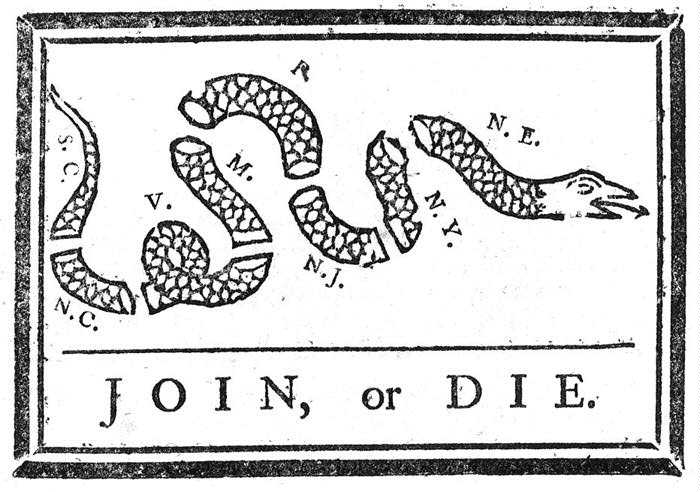
    I chose this particular cartoon because its significance is the deeper meaning to the picture, which is also very obvious by the visual imagery. The cartoon entitles “Join, or DIE”, a phrase specifically placed to be alerting and outlining throughout the picture. Aside from the bold words written across the picture, we have behind it a snake which is divided into different pieces containing acronyms which seem to be different states. What exactly did this picture have in mind to send as a message to its viewers? This is why and what we are here to find out.

    This cartoon stands out through all the humorous, visually-strong cartoons that I can find due to its significance in time era and rarity through originality. What I mean is that this image is an early political poster created by Benjamin Franklin. Why must one of our most highly viewed men in our culture use such vulgarity and precise deaconess to possibly persuade an audience to “join” some sort of organization that had planned? At first, it didn't make sense to me; why would such a lawful and righteous time such as then use such a dark, malevolent message behind? It all made sense: this picture dignifies the darkness and the illicit behavior we have always influenced onto our society. All these wrongful and ridiculous warfares and bloodshed seemed to never make sense until now. Benjamin Franklin, one of our founding fathers, is simply stating that the political union is not of truth, honor, or nobility, but of power, strength, and loyalty. It shows the true American idealism---the truth America in the flesh. The snake is also a symbolic way of representing our country and its intentions; as the country slithers through the high, green weeds and grasses throughout the Western plains. The snake, as mentioned, is divided into particular states which indicate the power that many of the founded colonies/town had begun to acquire through unity and political power. The fact that symbolism and historical importance comes together to one into a large picture shows how relatively easy it is for a community and country to be conveyed by such a simple picture such as this one. The phrase “Join, or DIE” is a message that is presumably what it means; join the government’s side or you will be attacked, desecrated, banished, and anything other word to suffice to your abolishment on this country or life.

    It is truly horrific to see our society direct into its own being, becoming a dark entity enthrilled by the acts of violence, corruption, and the need to oppress the weak, but what makes it even more sick is how we had been so blinded for so long and we had not seen the birth of darkness hatch right before our eyes----before our historians, our politicians, and oblivious, possible heroes. This picture is like digging up a time capsule that presents a prompt to protect society by fighting future issues. By finding this picture, I realize how easily manipulated we have been to miss such a large, iconic picture such as this to alert our society that it is a message: evil does exist and it runs our government. Evil not in the mythological, fictional sequence of large wings, sharp fangs, and horrendously blade-like claws, but of men, viewed as heroic and influential, to be the same men we fear today: terrorists, burglars, murderers, etc. “Join, or DIE” is a quote that would mean so much more than Benjamin Franklin had ever portrayed it to be: it would be the epitome of violence and demeanor towards an innocent society that only followed its leaders due to believing they were, too, longing for righteousness and improvement. We have seen this in the news before or our history books; whether you are a black man or a white man, if you do not abide by the gang of suited men, then you shall feel the wrath of power that cannot be justified nor can it be made right---and that’s how we must live---for the power is in the hands of the criminal as we are sought to follow his orders.

Wednesday, November 5, 2014

The Steel on JFK: Question 2


J.F.K and the Steel Industry 


*http://izquotes.com/quotes-pictures/quote-communism-has-never-come-to-power-in-a-country-that-was-not-disrupted-by-war-or-corruption-or-both-john-f-kennedy-100683.jpg
  
     In various situations in which persuasion and convincing arguments came to hand, rhetorical strategies and reason become a man's best friend. In 1962, America had almost reached rock bottom when the economy of the country began to fall. But within the specs of ash and dust, Americas began to reunite itself to being whole again. Through the dim light shining through struggle, one particular event held the U.S on a thread; the steel industry began to raise prices for the sake of selfish greed and power. Let's evaluate the person who fought against this disillusionment: John Fitzgerald Kennedy.

     Of all the Americans who sought to seize the existence of corruption, there was John Fitzgeral Kennedy. Although he himself made mistakes during presidency, one of his iconic attemps to save the country was to antagonize steel companies whom were raising product prices. "If the rise in the cost of steel is imitated by the rest of the industry, instead of rescinded, it would increase the cost of homes, autos..." J.F.K shows evidence of using intellectual persuasion into his speech: by including the lives of the citizens. His usage of involving people was an advantage of using emotional appeal to engage readers and the audience. Another strong use of rhetorical strategies had been the technique of reinstating the many lives and occupations that would be affected by the many issues burdened upon the nation, using symptahy and contemporary connection (1962) to how the world is and will be without the fighting of raising prices. Let's also look at some of the comaprisions and supporting evidence that J.F.K uses to state the issue; with such a long sppech, he ought to catch the attention of at least some. 

     Though Mr. Kennedy's intentions were to heavily affect the audience and industries who has interefered with politics, the speece itself reinterates a noble usage of rhetorical strategies and appeals to connect fact and emotion to come into play, while also using the truth and statistics to back up his main argument. Using present events such as confliction in the Vietnam/Cold War, Kennedy emits an argument revolviing around the pain and trouble found already in such a large controversory of war, and having steeling being raised financially can affect the country's money, which was immensly needed at the time. "...a few gigantic corporations have devided to increase prices in ruthless disregard of their public responsibilites." This method was one in which the speaker analyzed the audience to be victims of the industry, too, and that the industries also have targeted the U.S Government. This causes the audience, or reader, to have the desire to want and anticipate this particular issue. 

    Other than his involvement in the Cold War and a beautiful, blonde vixen, John F. Kennedy is recognized to one of his manipulative quotes stating: "Ask not what your country can do for you, but what you can do for your country." This quote is essentially a clever, stealthy way to use rhetoric strategies against the community. John Kennedy might have been one of the smartest presidents and iconic leaders this world has seen due to the fact that he has used rhetorical strategies and intellectual manipulation to be able to persuade, evaluate, and hide information from his viewers. Was the president a bad one? I am not one to judge, but as a writer, I can tell his skill and knowledge has amplified his ability to lead and control a country.

Tuesday, November 4, 2014

"...Now I'm Scared"


By: Zen Pencils

"...Now I'm Scared."


  I, as a person, believe everyone living and breathing in our world has a purpose and we all have possibilities to do anything we set our minds to. As vague as this ideal is, not many aspects of life as a 21st century student and child has boosted my will to strive for much more than I believe I can do. Education, in my opinion, is within our grasps everywhere and anywhere. The school system has been truly a positive development throughout mankind's history; people generations before would kill for the type of education and privileges we are handed freely, but school is not the only facility of learning. Learning, by definition, is "the act or process of acquiring skill or knowledge" School definitely takes a large role of directing students and children to the right path; the path to understanding how important education and knowledge overall really is, but school cannot be the only lane in which everyone shall and can take to success. It takes more than large textbooks to teach a student that he or she is truly useful to society. Despite the incredibly illicit and violent reputation we have as a country, one thing many nations cannot take away from us is the amount of opportunities we have: we can reach success with or without school institutionalization. 

   This particular cartoon by Zen Pencils truly inspired me not as a student but as a thinker---as someone who cannot measure to the authorities' opinions and desires in the academic system. Maybe when I am out of the school system as well, my abilities will not satisfy or suffice to a higher employer or maybe my love and personality won't be enough for a lover, but I must understand that there are so many ways of living life, yet we aren't being shown that pathway. It's as like we are on a long, steep hike which seems to have only one pathway. While many walk along the path paved for them, you wonder how the hikers at the top of the mountain arrived there so fast---did they fly, did they run, did they teleport there?! They didn't follow the path given to them, and their steps show  very difficult obstacles, so how did they succeed? You disregard their abilities on how/why they got there so fast, so you continue to walk along the paved road. There are signs that frequently remind you that it is "This Way" or "The Right Path", but realistically that paved way is not for everyone; not everyone has the endurance, the knowledge, the will to get up that one track. You then witness the struggles and failures of others; these people are assumed to be weak or hopeless because they cannot go up the hike which is recommended to them. Did these "weak" or "feeble-minded" people fail to their own expectations, or the expectations of others?  Though my story cannot truly compare the struggles of overall human concept of success to a hike, it expresses the possibilities of everyone and anyone who is wiling to succeed.

   Malcolm X famously said "By any means necessary" in the form of aggression towards fighting oppression and segregation in the 1960's Civil Rights Movement, but for the millennials and up-and- coming generations, are we still being oppressed? Oppression, not in the form of brutality or violence, but the shape of  "a wolf in sheep's clothing", because we are being oppressed and subjugated by the higher officials; whether it would be managers, bosses, politicians, and even presidents. Darwinism also supports the idea that man will and has taken a step backwards instead of forward through evolution because we simply cannot improve a society that is based on violence, greed, and control. The same people making corporations and jobs do not want individuality and creativity, they want the students and people willing to do anything and everything he or she says, which is a slave, or in modernistic terms, a robot. The interference of a man with a conscious can affect a business; the way in how they truly get their money. People with conscious are the same people who have been killed or prosecuted: Abraham Lincoln (killed by an antagonistic Confederate), Malcolm X (killed by members of his own religion who found him to be too powerful), J.F.K (killed by an unknown suspect but remains to be reasoned for his exposure to US corruption), Edward Snowden (wanted for his exposure of US actions to invade citizens' private conversations), and countless more have been disembarked and engaged to retaliate from their positions to fight oppression, or it shall come to death somehow. These heroes and legends leave their name into our nation, not as heroes, but as individuals; as icons and brazen soldiers to an illicit government and life. Then there is the side which believes in order and guided pavements, where shall this take us?

    While ranting about the negativity of having to abide by institutionalization, what are some of the benefits and pros about this side? School is a large part of my argument, which I believe seems to become the one and only way to become successful in this life of various opportunities, but I do also believe that school was never and still does have good intentions. School teaches us students to become fascinated and intrigued by our involvement in society. School encourages us as individuals to be guided to a future which can benefit both society and man through his and its struggle. Just as school, the concept of education and higher knowledge is simply inspiring but cannot be assessed in a single-filed, mandatory way. You cannot expect students to strive extremely well in every subject because it does not define the goodness in mankind: we are not perfect. Will having straight A's on the piece of paper called a report card have such a dramatic alteration to my well being and life as a human being? If you live in the 21st century, it is true that you must abide by these restrictions. In the cartoon, it points on how the system of the world simply gives you a piece of paper showing others that you are capable of work. Are we so minimal, so low, so degraded that we as a part of the world must be given a piece of paper to enable others to believe I can and shall accomplish? Must I have a paper inquire letters and numbers like 4.0 or As to define who I truly am? I believe these grades and academic scores do show significance; it shows others what I can, as a worker, can do to please my boss, nothing more. This 4.0 GPA does not grant me access to explore the world or solve world conflicts, but grants me a chance at spending thousands of dollars years later in another facility which falsely replicates the realities of the world or to prove to an employer that I am a good listener. This is not of rebellion----not of the defiance to man, not of attacking man's wrong doings---but of the actions that should and will be taken as my own person to set ambitious goals and sail into the direction where I want my future to be . If a student, so overwhelmed by the rules he had been given by society, had accidentally made a mistake to not meet academic standards, is he truly a failure? Will the effect of a B on his 4.0 GPA cause atrocious, maniacal changes to how his life and expectations would be perceived? Sadly, due to the way society accommodates enslavement and manipulation, yes, his or her life will be affected due to academic lack-there-of. But the world causes us to believe that because we cannot succumb to such academic struggles, that we cannot become what we want; we cannot be innovators, the new Steve Jobs or the Bill Gates of our generation, for what, a couple of letters and grades that defies the true meaning to creativity, individualism, and difference? That is what is wrong with society: being out of the box or different makes us look like black sheep while we are all truly beautiful. Our creator, whether a man in the sky or a scientific theory, made us different and unique in every characteristic. 

    The fact is, we sometimes cannot suffice to the standardized beliefs of humans around the world. We have forgotten basic human rights, ethics, and beliefs to simply learning to please one another: to please your parents, to please your teachers, to please your bosses, and more, and what if you cannot reach their wants and desires? You are admitted into jail, or into a facility that degrades your value as a human. The picture above is much more than a tale of school institutionalization; its a tale of realization, adventure, born-again values, and life passed the single-filed line. It takes more than a piece of paper to accomplish success; it takes time, patience, innovation, uniqueness, and much more than just a grade that your childhood teacher gave you. The enslavement of man has never been uplifted because we have always been enslaved by the higher authority in which holds us inferior---this is basic, evil human nature as we know it. Understanding the values of life just becomes much more than getting grades, but to become a better me. To find ambition in oneself can be beautiful and explosive: the expanding of one's knowledge can go from learning new things everyday to trying new things everyday. One John Mayer lyric truly sums up my argument on the system "You read all the books, but you can't find the answers..." This line truly amazes me because it involves so much more than books: our society outlines textbooks and school to be the only specific way of learning, but learning is all around us. You can pick up a tremendous amount of intelligence through the works of your own curiosity. Instead of measuring intelligence by paper and pencil, one should measure intelligence through experience, creativity, and curiosity. President Roosevelt once said, "Life must be lived and curiosity kept alive. One must never, for whatever reason, turn his back on life."

      In the end, it is up to you to decide what you want to be. Even if takes years and years to overthrow obstacles given to you by the standardized, modern world, you can be and do anything you want this life offers you if you have will, desire, and persistence to get it. Life is all around you, but instead of sitting in a chair, living life in repetition, you must grasp life everyday with bitter curiosity and defiance towards the tedious life we live. Many just live their lives thinking they have succeeded in life, but only work succeeded them. They live abiding by a schedule at school; waking up, going to school, study, then go to sleep. Then years later, they get a job, surprise, more repetition; wake up, get to work, sit behind a desk for hours, then go home to do the same thing all over again. Life is about grabbing the bull by its horns; you have to truly live through intuition, not ludicrous, through curiosity, not evasiveness. If you want to become a lawyer, train yourself to learn how to elaborate and speak to others---develop your assets as a lawyer, not as a worker. If you are planning to become a mechanic, fix that old car your dad couldn't---study its engine, from the transmission to the smallest fuse. If you want to be a writer, initiate priorities for you to improve in ways that no other author could and create stories no one has ever heard before! The world is full of possibilities, but how can we grasp these possibilities if it is locked behind the fence society found unbearable and inappropriate?


AP Language: Question 3 "Television"

Television

*http://sandiegofreepress.org/wp-content/uploads/2013/02/political-puppets.jpg


     Maybe Darwin's Theory might end up happening after all: an evolutionary development of man, but the sudden destabilization and step back of improvement, into the return of becoming less than of man's expectations due to modernistic values. A futuristic, innovative technology such as the television has slowly retracted the purpose and definition of innovation due to the reluctance of the component becoming a weapon of mass destruction which relies on the death of individuality. While our screens became larger and wider, our brains have rotted and narrowed to minimal membranes which feeds on the influence of a talking box. Barbara Ehrenreich writes about the pessimistic view in the "garage" found on television in a passage from her writing, "The Worst Years of Our Lives" Let's first get in depth with what television is all about; is the television screen truly "dangerous"?

     Civilizations centuries before now would be in awe at the sigh of where man has taken technology, but is this step-forward in technology a step-back into mankind's evolutionary development? Ehrenreich states that "...you will never see people watching television (within the screen). This excerpt does not exactly portray a comparison to literal terms, but expands in the form of understanding how significant the TV affects people and the daily lives of these viewers. This is where the media industries feed on the lack of action and creativity humans have today and even back when the development of such devices were being processed, "Modern people, i.e, couch potatoes, do nothing that is even shown...(it is either dangerous or would involve getting off the couch)" The author is simply saying the reason why the world watches television or why it is so drawn to the lucid effects it has is due to the fact that it brings an entertainment beyond our reach, for example, skydiving, gun fights, etc. By using the television to become a significance in the American household, with the poison of fictional/ideologies in the actual screen, society becomes a unit enthralled by manipulation; it makes people feel as if they are being included in these events or create a sense of adventure without actually having it. Is Barbara Ehrenreich telling the truth? Let's analyze why and how.

     The author, as a woman antagonized by modernistic priorities, asks the audience "So why do you keep watching?" This dignifies the importance the audience has on her writing to be able to reach her message into your mind. The television is just as dangerous as the author portrays it to be. While is not in the sense of danger whereas the audience are physically harmed, but are mentally and subliminally harmed. TV has become a priority in which we believe can relieve stress and cause ecstasy, while it is truly an object built to manipulate and persuade viewers by having such closed, naive minds to be a benefactor to businesses and regurgitate the interests of a blinded humanity. The author's ideals seem to perceive truth because it is a difficult theory to obligate corruption in your society, but it must be done to open minds to knowledge which can perhaps challenge the works of the media puppeteers. Going back to her question, it remains a mystery how bizarre a set of people can be so easily altered mentally through the works of commercialism and capitalism through a society enriched with beneficiaries and wealth. The direction in which the essay turns to is a deeper meaning to how a person or a community of people can relatively open their eyes to see the media being native to themselves.

     We have gone through war and violence, witnessing bloodshed and corruption toward our country, but the television is a form of weaponry because it lives in our lives everyday either supporting the puppetry through feeding within these shells of control or fighting the media to prevent anymore illicit behavior found in swaying society as a whole. The television withholds a power over us' a sense of involvement and neediness that is sugar coated to look and feel harmless. The television is a world in which is portrayed in a fictional, adventurous way used to direct the audience to become a generation of slaves of their own materialism and fascism. The only true way of fighting the industries and understanding its setbacks requires us to listen to people like Ehrenreich to reveal disillusionment and crooked values of our culture because this trait of analyzation can be the reason our civilization ends in the hands of the enslavement of the people by the media, ot the fact we, as a society, can challenge and fight for our world to become honorable and dignified.

Friday, October 31, 2014

Autobiography...Sort Of...


            A mediocre, gruesome horror movie based upon a video game once included a very wise phrase nonetheless of its poor cinema work that has embarked into my heart like a carving into a tree: “Mother is God in the eyes of a child”. With the loving smile she shines upon me each blessing of a day, or the loud, anointing scolding reigning from her voice for my wrong doings, my mother is a few of the things in life which I shall never take for granted and for her I strive to live and see my goals being accomplished with her alongside. Whether it is giving me tips to relieving the stress of friendly relationships or having to understand such a conflicted, odd child like I, “mommy” has always been there at my side, right or wrong. For I wish her the riches and blessings she deserves, she is, besides myself,  one of the building factors to the desire for a higher education, success, and nirvana.
            Throughout my schooling experience prior to high school, I assume I have maintained a reputation of ignorance and obnoxiousness (some say I smile too much) through my grade school years and also my junior high years. Although I do look understandably ridiculous sometimes in the way I act, I would like to believe that there is something in my noggin that clicks from time to time. As a child, I was analyzed to be a part of the gifted program at Gardner Street Elementary School and I was able to be accepted into John Burroughs Middle School under its S.A.S branch (School for Advanced Studies). I do not feel as if these names were given to us students as a way to shun others and taunt for a higher status, but I am grateful anyways for being recognized to be a part of the knowledgeable.
            I would like to consider myself an enthusiast for the study in the English and Literature. Although English is not my strongest suit, I believe the class revolves around knowledge and sensibility to what I actually want to learn in life. In my opinion, the only thing that schools have been missing all these years is the strategic method in which paves students’ roads down education through a creative, individual approach to really find oneself. The desire and will to pursue knowledge is an incredible thing and is amazing because its outcomes can be tremendously unreal, but the only way we can pursue these goals is if we what we’re looking for. As a student, I have always wanted to learn to dip into the world of words. The power of words is remarkable because it branches out to multiple characteristics of studies and life; Literature can branch into History to Science to Psychology to Law, etc. With this in mind, I feel as if Literature is something I am willing to do than I am enforced to. Being well rounded is a perfectly satisfactory way to become, overall, developed as a student, but what good are those skills if we weren’t taught to direct them into something we find interesting?

            As a student being a part of the SAS program at John Burroughs Middle School and the gifted program as a child in grade school, becoming a freshman in Fairfax had been an extremely insufficient transition into the steps of adolescence. High school has truly affected the way I think about everything: from life, to family, to the future, back to the past, etc. One of the most significant events in my freshman year and my life is coming to the realization of trying to stop a moving a train. I realized how rapidly fast time has gone: it felt as if just years ago I had been learning my ABCs, but now I was years away from being a young adult, entering the blistering cold world. This thought of independence and seriousness pressed weights down onto my mind; what happens then? With all these lingering thoughts hovering around my noggin, and all the stressed that came along with those thoughts, I was not entirely happy with the school environment. My classes were average and lower than the usual classes I had become used to. Thinking these classes were too easy, I became bored and irritated in why I had not been in other classes, but my mind began to unravel. Stepping into my 6th period class, I am welcomed by a tall, husky Caucasian man with long black hair who just shouted the vibrancy of “Hi, I used to love Heavy Metal!” This man, dressed casually with green shorts and a black T-shirt, had not exactly shown a reputable representation of himself to be a teacher. As time flew by in his classroom, I realized something important in such a cliché situation: “Never judge a book by its cover”. I had mistakenly judged a man for his aesthetics rather than his mind. Mr. Jacovo had made an impact on my life because his unusual thinking and out-of-the-box mindset. He encouraged not only well-structured writing, but a body of work that represented a sense of power and knowledge brought together into one paper. From analyzing contemporary movies to breaking down the corruption in a subliminal text, Mr. Jacovo had been of the most influential teachers I have had since. His humor and dedication of actual teaching became one of the reasons why English, and school itself, has become not a necessity, but a desire for me.